Red Hot Chili Peppers at the Hollywood Palladium: Why the L.A. Show Matters
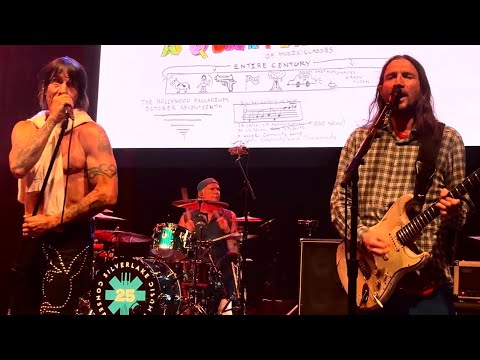
A fan-shot YouTube clip labeled Red Hot Chili Peppers “Can’t Stop” live at the Hollywood Palladium 10/17/2026 has the kind of raw, slightly chaotic appeal that makes concert footage travel fast: bodies moving, phones held aloft, and a song built to turn a room into a communal cardio session.
There is an important asterisk, though. The video title alone does not independently confirm the date, the billing, or a complete setlist, and no official event context has been provided alongside it. So this is not a victory lap for a confirmed Palladium booking. It is a look at why the very idea of Red Hot Chili Peppers playing the Hollywood Palladium would matter so much to Los Angeles—and why a clip of “Can’t Stop” feels instantly believable in that particular room.
A hometown band, minus the stadium moat
Red Hot Chili Peppers are one of those rare Los Angeles bands whose identity remains geographical even after global fame has made geography largely irrelevant. Their story is stitched to the city’s restless, sun-blasted contradictions: punk clubs and funk records, Venice looseness and Hollywood ambition, reckless youth and enormous arenas.
That is precisely why a Palladium-scale appearance would carry a different voltage than a normal large-venue stop. Stadium shows have spectacle, obviously. They also have distance. Even great ones can make a band feel like an expensive weather system seen from several zip codes away. The Palladium shrinks that gap. It puts a major act back in a room where sweat, sightlines, bass frequencies, and bad decisions all become part of the architecture.
For a band accustomed to commanding immense outdoor fields and arenas, an intimate Hollywood date is not merely a smaller gig. It is a change of grammar. The songs have to speak in close-up.
The Hollywood Palladium has always understood volume
Opened in 1940, the Hollywood Palladium has lived enough lives to make most venues look underqualified. It began as a ballroom, hosted major figures from the swing era, and eventually became a crucial Hollywood stop for rock, punk, pop, hip-hop, electronic music, benefits, premieres, and the occasional event that seemed designed by somebody who had misplaced their indoor voice.
Its staying power is rooted in its flexibility. The Palladium can feel grand without becoming impersonal; it has the physical heft of a landmark but retains the pleasantly unruly energy of a room where something might go gloriously off-script. That balance is catnip for bands with genuine history. A legacy act does not have to cosplay its past there. It can simply play loudly and let the building do some of the storytelling.
For the Chili Peppers, the setting would carry especially sharp local resonance. Hollywood has often been treated as shorthand for the music business at its most polished or predatory. The band’s best work, by contrast, thrives on friction: funk versus punk, tenderness versus chaos, precision versus the feeling that the whole thing could fly apart in a very entertaining way.
Why “Can’t Stop” is the obvious pressure test
Even without a verified full setlist, the appearance of “Can’t Stop” in the video’s title makes emotional sense. It is one of the band’s most durable live weapons: a lean, percussive surge with a riff that announces itself like a streetlight flickering on at midnight. There is no need for ornate production to make it land. In fact, too much polish would be mildly suspicious.
The track also condenses several enduring Chili Peppers traits into one compact blast:
- Flea’s bass-forward propulsion, which turns a groove into an engine;
- John Frusciante’s guitar language, economical when it needs to be, explosive when the moment asks for it;
- Chad Smith’s hard-driving feel, the difference between a beat and a stampede;
- Anthony Kiedis’ rhythmic vocal attack, less about pristine vocal decor than forward momentum.
At the Palladium, “Can’t Stop” would not need a grand narrative. The room supplies one. A hometown crowd hearing that opening figure at close range would understand the assignment before the first lyric arrives.
Intimacy is not nostalgia—and that matters
There is a temptation to treat every smaller-room appearance by an established band as a nostalgia exercise, a chance to pretend the clock has been generously rewound. That reading misses the point. Red Hot Chili Peppers are not interesting because they can recreate a youthful club-band fantasy. They are interesting because their catalog has survived enough eras to be tested in different conditions.
A Palladium show would put the focus back on the physical mechanics of the band: how the rhythm section locks, how a guitar part changes the temperature of a chorus, how a familiar song behaves when thousands of square feet of arena infrastructure are removed from the equation. It is less museum exhibit, more stress test.
It would also underline a truth that Los Angeles occasionally forgets while chasing the next opening-night party: the city’s musical history is not only preserved in famous records and mythology-heavy street corners. It lives in rooms. The Palladium is one of the rooms where scale still feels negotiable—where a band can be globally famous and, for one night, sound dangerously local again.
What needs confirming before the applause starts
Fan-shot footage is valuable. It catches the unvarnished electricity that official clips sometimes sand down until everyone looks like they are performing in a luxury appliance commercial. But it is not, on its own, a complete record.
Before treating the October 17 date in the circulating video title as established fact, readers should look for confirmation through the artist’s official channels, the Hollywood Palladium’s event listings, or reputable concert databases and reporting. The same care applies to the show’s lineup, the full setlist, special guests, and whether the footage represents a public concert, a private event, or another kind of performance.
That caution does not drain the clip of its appeal. Quite the opposite. It sharpens the question hanging over it: what happens when one of Los Angeles’ biggest musical exports steps into a room that still remembers how to make fame feel close enough to touch? If the Palladium date is confirmed, the answer will be louder than any comment section.